The model consists of three distinct pillars designed to address the issue from legislation to enforcement and community awareness.
The first pillar was the drafting of the Glassman Bill in 2022, an amendment to the Criminal Code that specifically targets those who falsely accuse others of sorcery. The legislation was submitted to Parliament as a Private Member’s Bill by East Sepik Governor Allan Bird and passed with a unanimous vote.
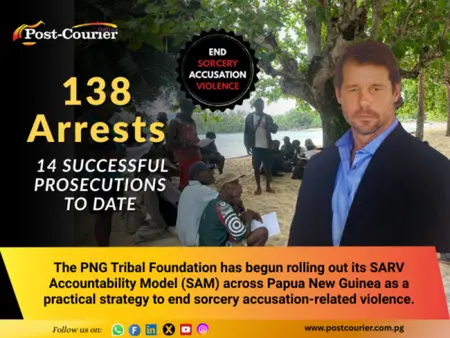
The second pillar of SAM focuses on the enforcement of that law through the arrest and prosecution of perpetrators. This is a significant undertaking. Working alongside police across the country, the PNG Tribal Foundation has supported investigations that have resulted in 138 arrests and 14 successful prosecutions to date. These cases send a strong message that those who accuse, torture, or harm innocent people under the guise of sorcery will be held accountable.
The third pillar of SAM is community awareness, particularly in areas where SARV cases are most prevalent. While continuing to support police in 48 active cases nationwide, the Tribal Foundation has developed a simplified explanation of the law that is now being taken directly to communities. When people understand the law and see that arrests are actually happening, they begin to realise that SARV carries serious consequences.
Early results show that SARV incidents are declining in areas where the model has been actively implemented.
Like many initiatives developed by the PNG Tribal Foundation, the approach involves building a practical model, piloting it in communities, refining it, and then scaling it across the country.
Last week, the Tribal Foundation team travelled Mushu and Kairuru Islands in East Sepik Province, where several SARV cases have occurred and more than 100 people remain displaced as internal refugees following sorcery accusations in their communities.
The awareness activities were conducted in coordination with Governor Allan Bird and East Sepik Provincial Police Commander Superintendent Christopher Tamari, along with members of his police team.
Two police officers accompanied the Tribal Foundation team as they visited communities on both islands. During the meetings, the law was presented and clearly explained. Community members were given an opportunity to ask questions and respond to the information.
In addition to awareness sessions, evidence was gathered on existing cases, with arrests and prosecutions expected to follow.
Communities with active SARV cases would do well to organise themselves and turn perpetrators over to the police. Under the amended Criminal Code, both acts of violence and accusations of sorcery themselves are now criminal offences and will be enforced.
For many years, SARV cases have continued to rise largely because there has been little accountability for perpetrators. That is beginning to change.
Rather than relying solely on forums, discussions, or awareness campaigns, the PNG Tribal Foundation is working directly with police, prosecutors, and victims to pursue justice through the courts.
Word is spreading that SARV does not pay. Those involved will be arrested and prosecuted.
Government agencies, churches, civil society organisations, and community leaders all have a role to play in ending SARV. Innocent Papua New Guineans continue to be tortured and killed because of false accusations, and this should concern every citizen.
Ending SARV will require more than talk. It requires going into communities where the violence occurs, holding perpetrators accountable, and ensuring people understand that the law will be enforced.
Justice, accountability, and awareness together are the pathway to ending SARV in Papua New Guinea.